What Business Leaders Should Know about AI Trends in 2025
As we usher in 2025, artificial intelligence (AI) continues to dominate many business and technological developments. Although generative AI has led the charge in this global race toward AI modernization, the latest trends in AI research, technology, and policies encompass much more than that.
Recap: AI-enabled automation
In May last year, we released a trend insight article about AI, API, and automation.
The appetite for AI-enabled automation has continued into 2025, with agentic AI identified by Gartner as the top strategic trend to look out for. There is reason to hop onto the hype: market trends point towards improved AI capabilities, especially for multimodality, reasoning, and decision-making. There is also reason to tread carefully, as researchers and policymakers work to understand the behavior and effects of AI.
Following the push for more automation, here are Orkes’ top four observations and predictions about AI for 2025 and beyond.
AI will continue to redefine human-computer interactions
AI and generative AI will continue to be the top drivers in redefining human-computer interactions.
Past: Voice Assistants
Voice assistants like Siri and Alexa pioneered new ways to interact with technology through voice commands.
Evolution: Immersive Tech
AR and VR technologies (like Meta's Metaverse) began melding physical and digital spaces.
Present: LLM Revolution
ChatGPT and Claude enable natural language interactions with computer systems.
AI-Powered Customer Service
Intelligent chatbots field queries and resolve customer issues before human escalation.
Information Search
Tools like Perplexity AI transform online information search experiences.
Multimodal Capabilities
Native text-to-speech, computer vision, and image/video generation capabilities.
Innovation Spotlight
Project Mariner
"A new way to use your browser" featuring:
- Multimodal interactivity
- Reasoning capabilities
- Task automation features
PaLM-E Robots
Embodied multimodal capabilities allowing:
- Dynamic environment interaction
- Natural language processing
- Human-robot collaboration
In 2025, we expect to see more projects or product offerings that will use AI to enhance digital and physical experiences in novel ways.
What does this mean for businesses?
Growth & Business Value
$15.7 trillion
AI's estimated contribution to global economy by 2030 (PwC)
Instead of rushing to tack on AI to any product, businesses should carefully weigh how such AI technologies can truly elevate their core business value before implementing them.
AI capabilities will keep growing, even if at a slower pace
AI performance may have slowed in recent months, but it has not hit saturation point yet.
Key Factors Affecting AI Performance
Compute
Data
Algorithms
Test scores of AI systems on various capabilities relative to human performance
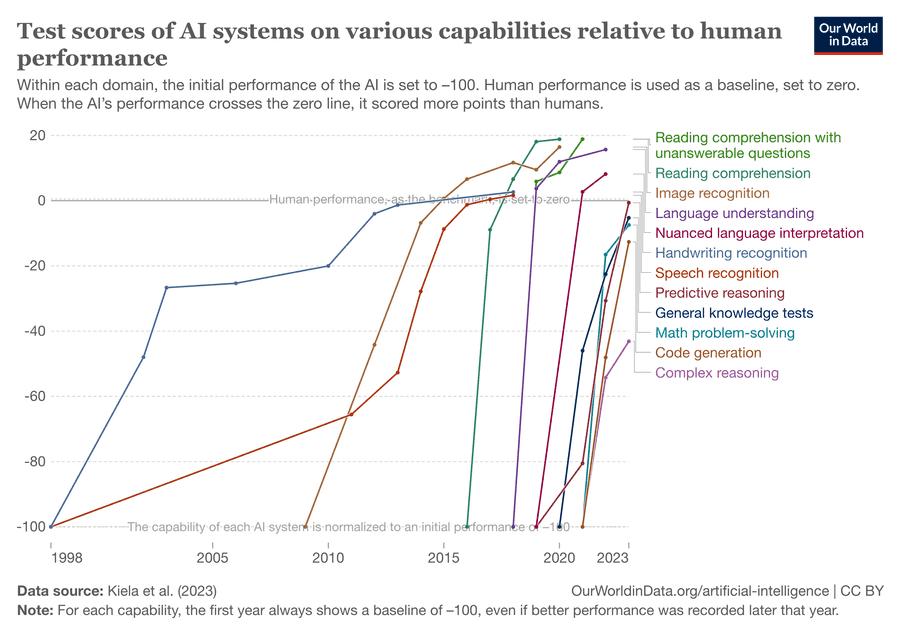
Data source: Kiela et al. (2023) | OurWorldInData.org/artificial-intelligence | CC BY
Note: For each capability, the first year always shows a baseline of −100, even if better performance was recorded later that year.
Current Roadblocks
Model Size Challenge
Large language models with billions of parameters showed slower performance improvements by end of 2024.
Data Limitation
Public human-generated data may hit its limit within 1-7 years, potentially capping AI progress.
Emerging Solutions
Transfer Learning
Enabling smaller models to achieve significant performance gains
Contextual Retrieval
Enhanced RAG system performance by Anthropic
Novel Architectures
SSMs and FANs improving reasoning capabilities
2025 Expectations
Greater focus on optimizing domain-specialized or smaller models
Improvements in reasoning capabilities, multimodality performance, and context windows/sizes
More AI techniques becoming feasible in real-world use
What does this mean for businesses?
Viable opportunities & use cases
- Advanced tasks involving complex reasoning and analytical thinking
- More affordable AI solutions with smaller, specialized models
- Enhanced decision intelligence and big data analysis capabilities
Autonomous AI is on the horizon
Early Agents
Rule-based systems with limited capabilities in complex situations
Current State
LLM chatbots with enhanced abilities and context-aware interactions
Future Vision
Fully autonomous AI systems with advanced decision intelligence
Current Market Landscape
Frontend Copilot
Generates functional code from website concepts
Gemini 2.0
Features agentic Deep Research capabilities
Persistent Agents
Handling complex, long-running tasks
2025 will be the year of agentic product releases, as both tech giants and startups contend for market share.
Opportunities
- Decision intelligence systems
- Tool-use AI agents
- Agent-building frameworks
Risks
- LLM hallucinations
- Unexpected behaviors
- Ethical concerns
What does this mean for businesses?
Time to invest and take up new ventures
Lowered Costs
Improved Productivity
Greater Innovation
Getting Started
Partner with AI experts
Start with proof of concept
Develop minimum viable product
AI governance and data privacy will play catch-up
Less than half of enterprises are compliant with existing AI regulations or actively working towards compliance.
Global AI Regulations
EU AI Act
First comprehensive AI law taking effect
Global Expansion
More countries expected to implement AI regulations
AI Governance Startups
New companies emerging to monitor and audit AI risks
Enterprise Security
Enhanced security measures by major LLM providers
Data Privacy Concerns
Data Leaks & Access Control
How will AI models constrain access to user-specific data in enterprise environments?
2025 looks to be the year when more frameworks, technologies, and regulations will come into place for safer, more responsible AI.
What does this mean for businesses?
AI literacy & due diligence
Implement Compliance Measures
Stay updated with evolving regulations
Mitigate Data Risks
Develop robust data protection strategies
Gradual Rollout
Implement AI solutions with careful consideration
Wrap up: AI in 2025
2025 is set to be another mercurial and fast-paced year for AI developments. Besides the growing buzz about AI agents, here is the summary of the shifting winds we expect ahead:
Productization
- More products
- More startups
- More giant-backed ventures
- Research to market-ready products
Scale
Choose from a wider range of AI models with:
Multimodality
Seamless transitions unlocking new AI interactions
Smaller Models
Specialized models carving their place in the AI landscape